
Brownstones, rowhouses and frame homes across Kings County
Spray Foam Insulation in Brooklyn, NY
Cooler top floors, warmer parlor floors and fewer drafts, with closed-cell or open-cell foam chosen for each part of your building and priced in writing.
- Free on-site estimates anywhere in Brooklyn
- Written quote naming foam type, thickness and R-value for each area
- Leaks, damp masonry and old wiring flagged before anything is covered
Insulation for How Brooklyn Is Actually Built
Spray foam insulation in Brooklyn has to work with buildings that were never designed to be insulated. Much of the borough is brick and brownstone rowhouses with flat roofs and shallow cocklofts, wood-frame two-families, and Victorian houses with balloon framing. We are spray foam insulation contractors who start from the building in front of us: we seal the air leaks, then add closed-cell foam, open-cell foam or blown-in insulation where each one makes sense, and we put every choice and price in writing.
What the climate asks of a Brooklyn house
Wikipedia's climate table for the Brooklyn (Avenue V) station shows a January average low of 27.5F and a July average high of 84.8F, with about 47 inches of precipitation and 24.5 inches of snow in a typical year. The borough is classed as humid subtropical. That means a house here has to hold heat in winter and keep heat and humidity out in summer. The weak point in both seasons is usually the top of the building: a flat roof over a thin cockloft lets the sun cook the top floor in July and lets heat escape in January. The second weak point is the bottom, where cold air comes in along the rim joist and through gaps in old cellar walls.
The code numbers for New York City
The 2025 New York City Energy Conservation Code assigns all five boroughs to Climate Zone 4A (Section R301.1). Its prescriptive table (R402.1.3) calls for R-49 at the ceiling; R-30 in a wood-frame wall, or R-20 plus R-5 continuous, or R-13 plus R-10 continuous; R-15 or R-20 continuous on a mass wall; R-30 at a floor; and R-15 continuous or R-19 in the cavity at a basement wall. The same code caps whole-house air leakage at 3.0 air changes per hour at 50 pascals. These targets apply to new work and to the parts of a renovation that the code covers, and they explain why foam shows up so often in Brooklyn: under a flat roof there is rarely room to reach R-49 with loose fill and still leave space for air, and closed-cell foam delivers more R-value per inch.
Closed cell vs open cell
HomeGuide lists closed-cell foam at R-5 to R-7 per inch and open-cell at R-3.5 to R-3.7 per inch. Closed-cell is dense and rigid, slows water vapor, and is the usual pick for cellar walls, rim joists, the underside of flat roof decks and any area that might see moisture. Open-cell is softer and cheaper per square foot, seals air well and absorbs sound, which makes it useful in interior walls and floors between units in a two-family house. Neither one belongs everywhere. On a wide open attic floor in a Flatbush or Ditmas Park Victorian, sealing the leaks and blowing cellulose on top usually costs less. On the inside face of a solid brick wall, we talk through moisture before recommending any foam, because old masonry needs a way to dry.
Spray foam insulation cost in Brooklyn
HomeGuide's 2026 guide puts installed spray foam at $1.50 to $5.00 per square foot, with open-cell at $1.50 to $3.50 and closed-cell at $3.00 to $5.00. For about 1,000 square feet of coverage it lists $1,500 to $5,000, and Fixr lists $3,150 to $7,500 for the same area in an existing home. A whole house runs $8,000 to $20,000 in HomeGuide's figures and $10,000 to $30,000 in Fixr's, and many installers set a minimum of $1,000 to $2,000 or more. In Brooklyn, access is often the biggest local cost driver: parking, carrying hoses up a stoop or through a cellar door, and working in a cockloft you can only reach through a roof hatch all take time. National ranges help you budget, but the number on our written estimate is what you pay.
Choosing among insulation companies
When you compare spray foam insulation companies or general insulation contractors in Brooklyn, a few questions sort out the careful ones. Ask what they will seal before insulating, and how. Ask which foam they plan for each area, at what thickness, and what R-value that gives. Ask how they handle the cockloft vents, the masonry walls and any shared roof or party wall. Ask how long you need to stay out after spraying; HomeGuide's guidance is 24 hours or more. Ask whether foam in living space will be covered with drywall or another thermal barrier. A good answer is specific. We put those specifics on every quote.
Rebates worth checking
National Grid, which supplies gas in Brooklyn, runs a Total Home Comfort Program for residential gas customers in Brooklyn, Queens, Staten Island and Long Island. Its program flyer lists adding insulation and sealing air leaks among the eligible upgrades, with incentives based on estimated gas savings. Program rules and amounts change, so check eligibility with National Grid before the work starts.
Our Services
Six kinds of insulation work, matched to the part of the building: the roof cavity, the walls, the cellar and the materials already in place.
Spray Foam Insulation
Closed-cell and open-cell foam that insulates and air seals in one layer, for flat roofs, rim joists, walls under renovation and cellar walls.
Learn more →Attic & Cockloft Insulation
Air sealing and insulation for flat-roof cocklofts, half-story attics and full attics, so the top floor stays cooler in summer and warmer in winter.
Learn more →Basement & Cellar Insulation
Closed-cell foam on rim joists and cellar walls to stop the cold drafts and damp air that come in at the bottom of the house.
Learn more →Wall Insulation
Insulating exterior walls in frame houses and renovated rowhouses: open stud bays during gut renovations, dense-pack or injection in closed walls.
Learn more →Blown-In Insulation
Loose cellulose or fiberglass blown into open attics, deeper cocklofts and closed frame walls, usually after the air leaks are sealed.
Learn more →Insulation Removal & Replacement
Taking out wet, moldy, flood-soaked or contaminated insulation, cleaning up, and putting in the right replacement.
Learn more →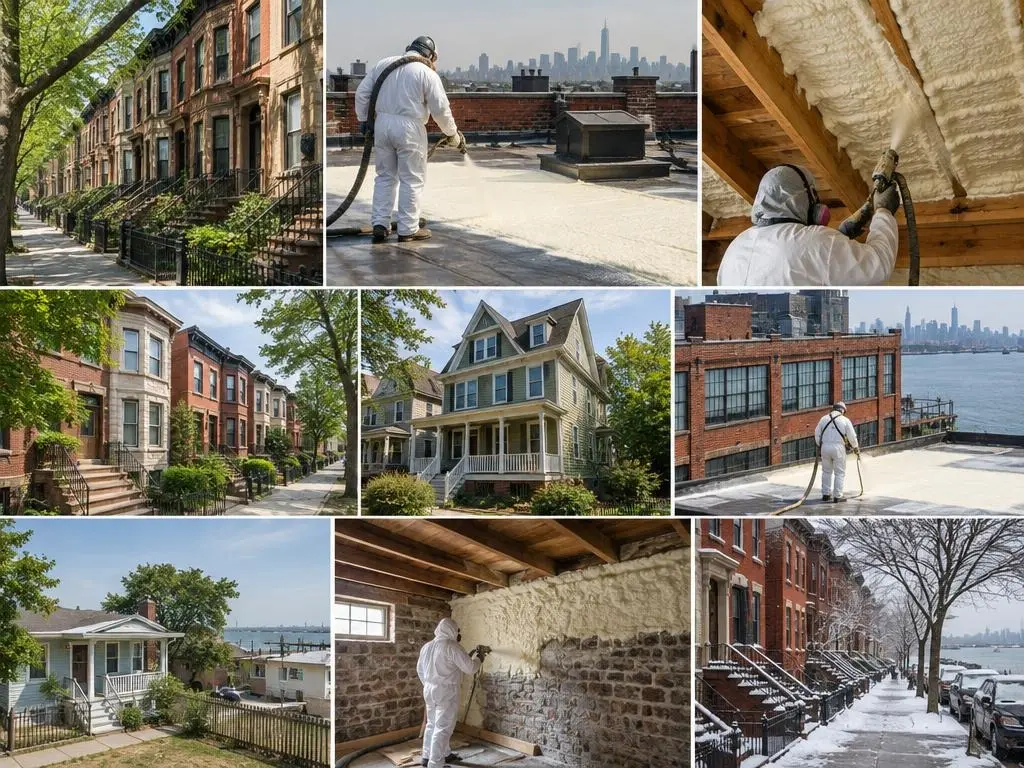
Why Homeowners Call Spray Foam Insulation Brooklyn
We look before we price
Every quote follows a visit to the roof cavity, the walls we can reach and the cellar, not a guess over the phone.
Air sealing comes first
Chimney chases, pipe and wire holes, top plates and the rim joist get sealed before new insulation hides them.
Material picked for each area
Closed-cell, open-cell, cellulose or fiberglass, chosen for the surface and its moisture risk, with the reason written down.
Quotes you can compare
Each area on the quote shows material, thickness or depth, target R-value and price, so you can line it up against other bids.
Common Questions
How much does spray foam insulation usually cost?
HomeGuide's 2026 national range is $1.50 to $5.00 per square foot installed, with open-cell at the low end and closed-cell at $3.00 to $5.00. Many jobs also carry a minimum of $1,000 to $2,000 or more. Access, thickness and prep change the total, and our written estimate is the price.
How much does it cost to spray foam a 2,000 sq ft house?
Foam is priced by the area sprayed, not the floor area, so a 2,000 square foot house might need far more or less than 2,000 square feet of foam. For a whole house, HomeGuide lists $8,000 to $20,000 and Fixr lists $10,000 to $30,000. In a Brooklyn rowhouse the party walls usually need no insulation, which shrinks the area.
How much does spray foam cost for 1,000 square feet?
HomeGuide lists $1,500 to $5,000 for about 1,000 square feet, depending on foam type and thickness. Fixr's range for an existing home is $3,150 to $7,500. Closed-cell at several inches costs more than a thin coat of open-cell.
Why do some people call spray foam a red flag?
The concerns usually come from bad installs: foam mixed or applied wrong can leave an odor, and foam sprayed under a roof deck can hide a slow leak from an inspector. Those are reasons to hire carefully, not reasons to avoid foam. We fix leaks first, document what was sprayed and where, and keep foam off masonry that needs to dry.
What R-value does New York City require in a roof?
The 2025 NYC Energy Conservation Code places the city in Climate Zone 4A and lists R-49 for ceilings in its prescriptive table. Code levels apply to new construction and to the work a renovation permit covers. Under a flat Brooklyn roof, closed-cell foam is often the practical way to get close to that number.
Should I use closed cell or open cell spray foam in Brooklyn?
Closed-cell is the usual pick for cellar walls, rim joists, flat roof decks and anywhere near the water, because it slows vapor and holds more R-value per inch. Open-cell is cheaper and good for sound control between floors and units in interior walls. We name the foam for each area on the quote and explain why.
Can you insulate a brownstone without opening the walls?
Sometimes. A cockloft can often be reached through a roof hatch, and a cellar ceiling and rim joist are usually exposed already. Solid brick walls are harder: insulating them means adding something on the inside, which is easiest during a renovation. We tell you what can be done from the openings you have.
Do I need landmark approval to insulate in a historic district?
Interior insulation does not change what the street sees, but work that touches the roof, facade or windows in a landmark district can need Landmarks Preservation Commission review. Park Slope, Brooklyn Heights and parts of Bedford-Stuyvesant and Crown Heights are designated districts. Check with the Commission before any exterior work.
Brooklyn Neighborhoods We Serve
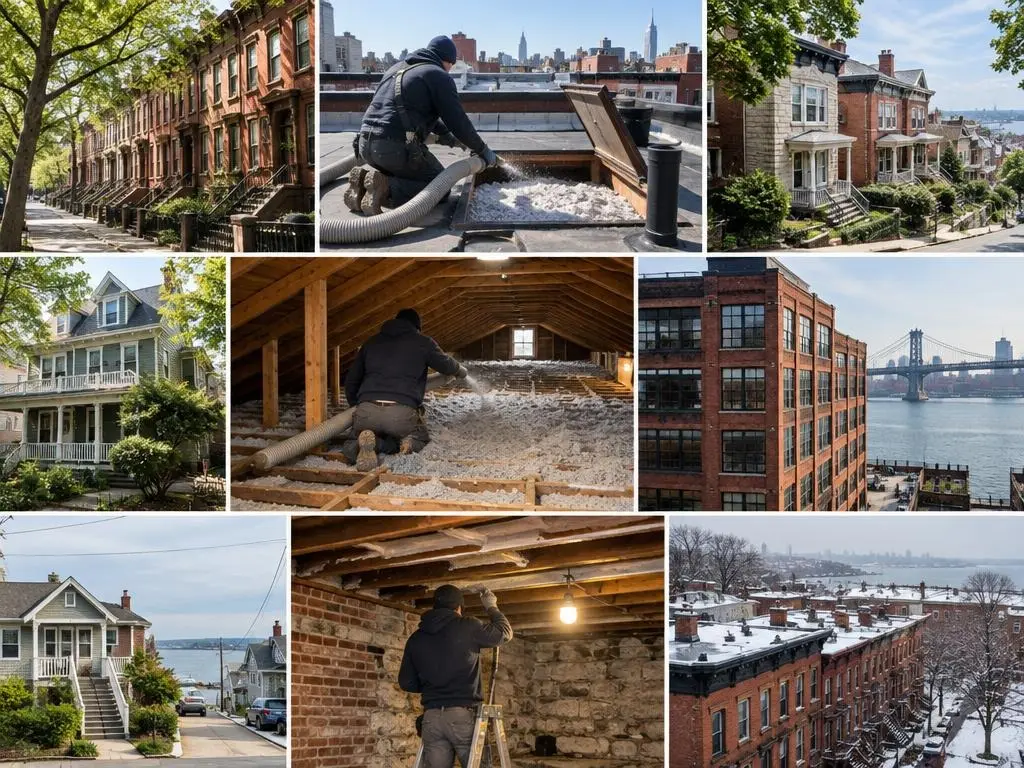
We work in every part of Brooklyn. North Brooklyn means Williamsburg, Greenpoint and Bushwick, where lofts in old factories sit beside wood-frame and brick rowhouses. The brownstone belt runs through Brooklyn Heights, Park Slope, Bedford-Stuyvesant and Crown Heights, much of it inside landmark districts. Central Brooklyn holds the Victorian houses of Flatbush and Ditmas Park and the larger homes of Midwood. To the southwest are Sunset Park, Bay Ridge, Dyker Heights and Bensonhurst, with two-family rowhouses and detached homes on the hills. Along the water, Red Hook, Sheepshead Bay, Gerritsen Beach and Canarsie face flood risk that changes how we choose materials. Each neighborhood page covers what is different there.
- Spray Foam Insulation in Brooklyn, NY
- Spray Foam Insulation in Park Slope, NY
- Spray Foam Insulation in Brooklyn Heights, NY
- Spray Foam Insulation in Williamsburg, NY
- Spray Foam Insulation in Greenpoint, NY
- Spray Foam Insulation in Bushwick, NY
- Spray Foam Insulation in Bedford–Stuyvesant, NY
- Spray Foam Insulation in Crown Heights, NY
- Spray Foam Insulation in Flatbush, NY
- Spray Foam Insulation in Ditmas Park, NY
- Spray Foam Insulation in Midwood, NY
- Spray Foam Insulation in Sunset Park, NY
- Spray Foam Insulation in Bay Ridge, NY
- Spray Foam Insulation in Dyker Heights, NY
- Spray Foam Insulation in Bensonhurst, NY
- Spray Foam Insulation in Sheepshead Bay, NY
- Spray Foam Insulation in Gerritsen Beach, NY
- Spray Foam Insulation in Canarsie, NY
- Spray Foam Insulation in Red Hook, NY
Get a Spray Foam Insulation Estimate
We come out, look at the building, and send a written price that names the material and R-value for each area.